Covered RV Storage Near Me: Make a Plan for Rooftop Solar
A canopy changes the light reaching rooftop solar panels. Build a battery plan around your actual equipment, permitted charging arrangements, and useful monitoring.

A covered parking space changes the conditions your rooftop solar system operates in. The panels may receive much less light, while some equipment inside the RV continues drawing power. Before relying on the setup that worked in your driveway, establish how the batteries will be stored, how you will check them, and what will trigger a visit.
If “rv storage covered near me” brought you here, the useful question is not simply whether the canopy blocks the sun. It is whether your battery plan remains workable in that particular bay throughout the storage period. The answer depends on the equipment, its approved settings, the loads left connected, and the available charging arrangements.
Do not turn panel wattage into a storage promise
The rated capacity printed on a solar panel does not tell you what it will produce under a canopy. In its solar-controller troubleshooting manual, Victron identifies shading, weather, panel orientation, and seasonal sun angle among factors associated with reduced production. Those variables are directly relevant to covered parking.
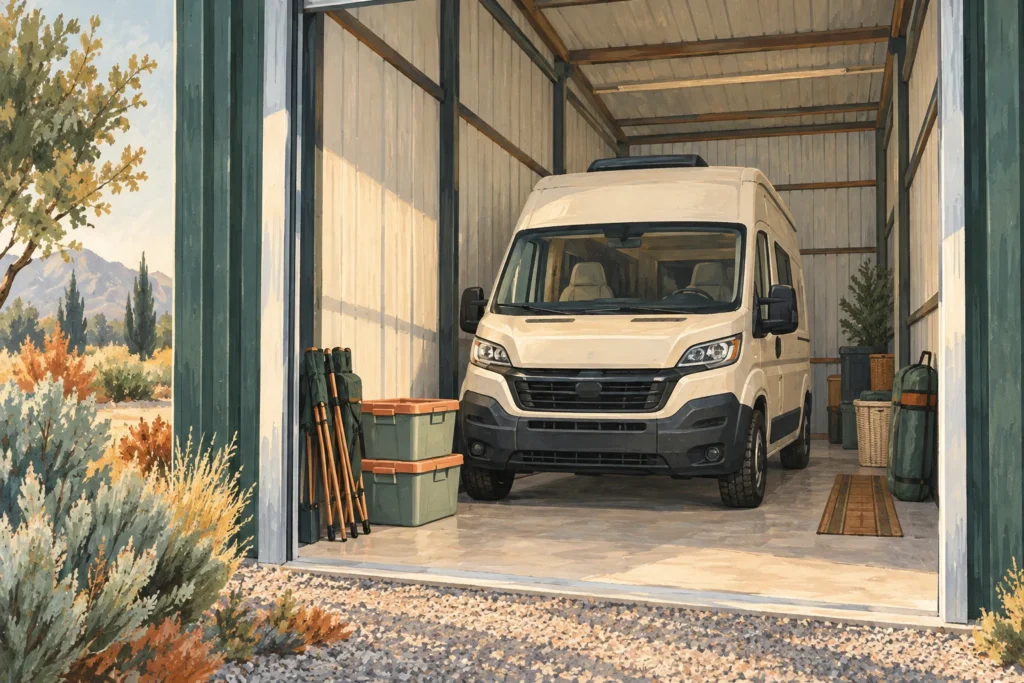
Observe the actual assigned bay from the ground. Note the canopy edges, adjacent buildings, trees, and the position of the roof panels once parked. A photograph of an empty aisle cannot establish the light reaching panels several feet below or behind the roof edge.
Do not move into an aisle, leave the vehicle projecting beyond its space, or alter the canopy to gain sunlight. If the permitted parking position does not support the chosen storage plan, change the plan or choose a different space.
Identify both the battery and the charger
Write down the exact battery model, solar controller, converter or inverter-charger, and any battery monitor. A motorhome may also have separate house and chassis batteries. Establish which equipment maintains each one; seeing healthy house batteries does not establish the condition of the starting battery.
Find the storage instructions for each installed battery and the compatible charging instructions. Do not assume every product described as lithium, AGM, or lead-acid has the same storage requirements. Replaced batteries may also need different charger settings from those used with the RV’s original equipment.
For example, Battle Born’s BB10012/BB10012H product manual includes specific storage, charging, and temperature guidance. It also calls attention to power consumed by fitted monitoring equipment. Use the current manual for your own model and ask the manufacturer or a qualified RV technician to resolve conflicting instructions; another owner’s preferred settings are not a specification.
Decide what genuinely needs power
Make a list of equipment intended to remain active. This might include a tracker, alarm, communications device, or monitoring system. Write down why it is needed and how its consumption will be established. Identify equipment that the RV manufacturer’s storage procedure says to switch off or otherwise prepare.
Have a technician clarify what your existing disconnect controls actually isolate. Do not infer that every device is disconnected because one cabin light no longer turns on. Equally, do not disconnect equipment indiscriminately: follow the vehicle and component instructions and account for any systems that must remain functional.
If you want remote monitoring, confirm the full connection path. A phone app that connects by Bluetooth near the RV is different from a system you can read from home. Remote access may depend on an additional gateway, data service, network coverage, and continued power.
Choose a plan before counting on solar
Three broad approaches are worth discussing with your equipment provider: manufacturer-approved storage without ongoing charging; an approved maintenance-charging arrangement; or a monitored solar-supported setup that has been checked in the assigned location. The right choice depends on your system and intended storage duration.
A power outlet can offer another option, but only after the operator confirms permission, service specifications, costs, and what happens during an outage. Do not assume an outlet visible near the bay is yours to use. Likewise, get permission before placing any portable panel or other equipment outside the vehicle.
For a monitored setup, record a baseline after parking and compare subsequent readings using the monitor’s instructions. The aim is to notice a meaningful trend, not to prove that one favorable midday reading represents the entire week. Ask your equipment provider to set the relevant action threshold and an appropriate inspection interval.
Solar and battery storage worksheet
Fill in this record before the first unattended period. Keep separate entries for battery banks with different functions or storage procedures.
| Question | Your record |
|---|---|
| Which batteries are involved? | Model, bank location, and house/chassis purpose |
| Which manual governs storage? | Document title, revision, and relevant section |
| What remains powered? | Equipment list and measured or documented consumption |
| What is the approved charging arrangement? | Solar, permitted shore power, or another manufacturer-approved plan |
| What can you actually monitor? | Reading available locally/remotely and its limitations |
| When is the first follow-up? | Date, responsible person, and access arrangement |
| What triggers action? | Manufacturer/technician guidance, alert, or missed reading |
| What is the backup? | Approved service contact and alternative charging or storage arrangement |
Add a note when the RV changes bays. A new parking orientation or different canopy depth can make old observations unrepresentative.
A small load can matter over a long interval
Suppose a hypothetical monitoring setup and other permitted equipment consume an average of 4 watts continuously. Over one day, that is 96 watt-hours; over seven days, it is 672 watt-hours before other losses or loads. This calculation illustrates accumulated demand, not the expected consumption of your equipment or a prediction of battery life.
Even if the owner sees 20 watts of solar production during one visit, that single reading cannot establish daily energy production. It says nothing about the remaining daylight hours, overnight demand, or several cloudy days. A suitable monitor’s accumulated readings and the system manufacturer’s guidance are more useful for deciding whether the plan is working.
If the balance is unfavorable, contact the equipment provider about approved changes. Adding a larger panel does not solve a lack of light under a solid roof, and a battery-protection shutdown should not be treated as the normal storage target.
Match the space to the plan you can maintain
A nearby covered bay can be attractive if you can inspect the RV on the required schedule. A more distant bay with a permitted electrical service may suit a different owner. Compare the complete routine: visits, equipment compatibility, power arrangements, and the ability to respond when a reading is missing.
Our covered-versus-indoor storage guide explains the broader space choices. Use the RV storage directory for a shortlist, then verify each property’s actual bay and policies. Keep rooftop solar as one measured part of the storage plan, rather than an untested reason to leave the RV unattended longer.
Sources
Keep exploring
Related reading.

Covered RV Storage Prices Near Me: Compare Equivalent Bays
A lower advertised rent can lead to the same monthly bill. Normalize canopy quotes for usable space, power, billing periods, and required charges.

How Much Is RV Storage Near Me? Build a Full-Year Budget
Turn local storage quotes into a realistic annual funding plan. Include seasonal rent, transfers, inspection travel, preparation, and a separate reserve.
Storage Units for an RV Near Me: Confirm the Permitted Uses
A unit that fits your RV may have rules about gear, visits, electricity, and repairs. Confirm the activities you need before committing to the space.