RV Camper Storage Near Me: A Plan for Folding and Truck Campers
Folding campers need a drying plan; removable truck campers need an approved unloading arrangement. Record both the parked footprint and the working space before booking.
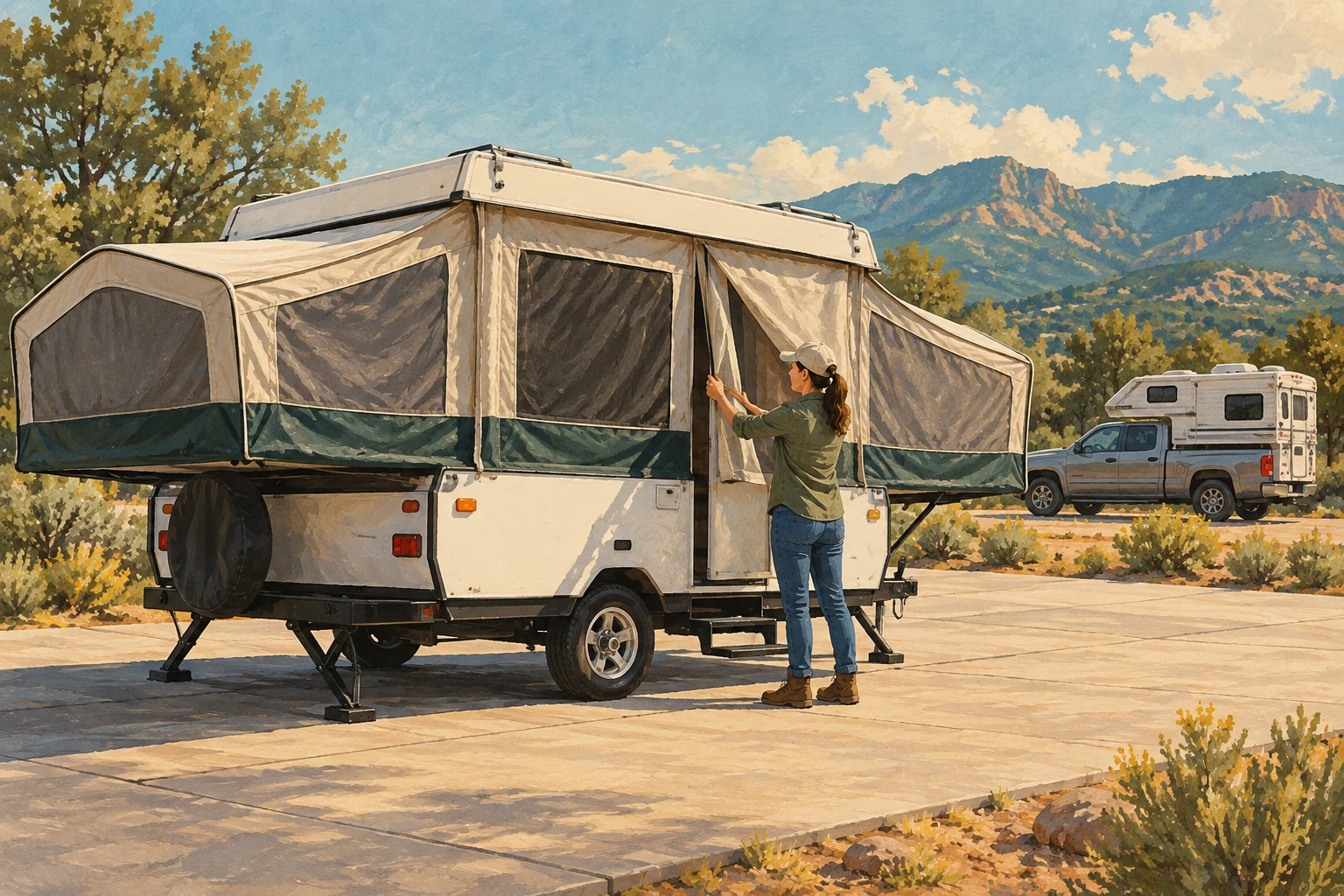
A folding camper and a removable truck camper create very different storage jobs. One needs a reliable place to dry and close its tent material; the other needs an approved unloading and support arrangement. A search for rv camper storage near me may return both under the same broad category, so explain exactly what you own before reserving a space.
The useful question is not just whether the camper fits while parked. It is whether you can safely arrive, prepare it, store it in the intended configuration, and retrieve it without borrowing space or equipment the operator has never agreed to provide.
Describe the camper in its storage configuration
Give the operator the make, model, year, and a recent photo. For a pop-up, explain whether it is a fabric-sided folding trailer, a hard-sided folding camper, or another configuration. For a truck camper, state whether the truck stays underneath it for the rental period.
Measure the real vehicle rather than relying on a model number. Include the tongue, rear accessories, rooftop equipment, and other projections that remain attached. Then make a second record for the space needed during setup, drying, or unloading. A compact parked footprint does not describe the full operation.
Ask the operator to confirm the actual configuration in writing. “Camper accepted” leaves room for a misunderstanding if staff expect a wheeled trailer and you intend to leave a camper body off its truck.
Folding campers need a drying destination
Plan where the camper will be opened after a wet trip. The Forest River tent camper manual emphasizes thorough drying before storage and reopening a damp camper promptly so it can dry. Use the manual for your specific model to determine the appropriate opening, cleaning, and closing sequence.
If the storage operator prohibits setup, the rented space cannot also be your drying area. You need another permitted location and enough time to use it. Confirm that arrangement before a rainy return, especially when you cannot open the camper at home.
Ask about temporary access to a designated preparation area, whether an appointment is needed, how long it can be occupied, and whether an extra charge applies. Do not assume an empty neighboring space or driving aisle is available. The property may need that area for access even when no one is parked there.
Look at the practical details of your own camper: room for extended beds, safe access to the entrance, and clearance for lifting the roof. If the plan requires the camper to remain open for drying, obtain permission for that duration and consider the weather forecast. Do not leave it deployed unattended simply because it fitted during a tour.
Record closed and working dimensions separately
Use two sketches or labeled photographs. On the closed version, mark the complete parked length, width, and height. On the working version, mark the extent of beds, the raised roof, doorway, and space needed to carry out the manufacturer’s setup procedure.
For example, a hypothetical folding trailer measures 16 feet overall while closed and needs 23 feet with its beds extended. A 20-foot parking space may accommodate the closed trailer if the operator approves the fit, but it does not provide the 23-foot working length. The owner must arrange another approved drying location rather than treating the size label as permission to extend beyond the space.
Record whether accessories must be removed or repositioned before folding. Keep the appropriate operating instructions with the camper, and avoid squeezing tent material into an arrangement that conflicts with them merely to meet a storage deadline.
Removable truck campers require a different conversation
An unloaded truck camper may need more approval than a normal vehicle reservation. Ask whether the facility accepts campers off the truck, which surfaces and spaces are permitted, and whether unloading and reloading can occur there. Confirm that the truck can approach and align with the camper at collection time.
The Lance truck camper manual contains specific loading, unloading, and support instructions, including firm, level ground and warnings concerning a camper in a raised position. Those directions illustrate why a generic internet recommendation about jacks or stands is inadequate. Follow the instructions for your camper and jack system, and ask the manufacturer or a qualified dealer if the storage arrangement is unclear.
Do not construct an improvised support setup because another customer appears to use one. Nor should a storage employee’s informal approval replace the equipment maker’s instructions. The facility decides what it accepts on its property; the manufacturer supplies the relevant equipment procedures. Both need to fit your plan.
Solve retrieval before unloading
Think ahead to a cold morning when you want to collect the camper. Who has the truck, who knows the loading procedure, and where are the required controls and equipment? If the jack system depends on battery power, include the manufacturer’s battery storage and recovery procedure in your planning. Do not assume the office provides a charger or lifting assistance.
Confirm whether the loading area remains accessible when neighboring stalls are occupied. Ask about appointment requirements and vehicle-movement services. Any promise that staff will shift another vehicle needs a defined process; a verbal “usually possible” is not a dependable pickup arrangement.
If you hire help, verify that the operator permits that provider on the premises. Put contact details and access requirements in the reservation record so an unfamiliar employee can understand the plan.
Camper configuration worksheet
Complete the relevant rows before comparing rental quotes. A blank approval field means another conversation is needed.
| Planning item | Folding camper | Removable truck camper |
|---|---|---|
| Configuration while stored | Closed/deployed, as approved: ___ | On truck/off truck: ___ |
| Parked dimensions | Overall closed measurements: ___ | Stored assembly and projections: ___ |
| Temporary working area | Raised roof and extended-bed space: ___ | Approved loading/unloading area: ___ |
| Preparation location | Drying location and appointment: ___ | Surface and equipment approval: ___ |
| Instructions | Model-specific setup/storage manual: ___ | Camper and jack manuals: ___ |
| Collection needs | Tow vehicle and equipment: ___ | Truck, controls, trained help: ___ |
| Facility confirmation | Contact and written approval: ___ | Contact and written approval: ___ |
Confirm the first move-in as a supervised appointment
For an unfamiliar property, arrive while the relevant employee is available. Recheck the assigned space and any preparation area before starting. If the actual layout conflicts with your measurements or support instructions, stop and resolve it while the camper remains in its transport configuration.
Keep your written approvals with the rental paperwork and update them if you change trucks, campers, or accessories. Our trailer storage guide covers planning for the tow vehicle, while the RV storage directory can help you find operators to ask about these more specialized camper arrangements.
Sources
- Forest River: Rockwood Tent Camper Owner’s Manual — tent material drying and camper storage guidance; consult the correct manual for your model.
- Lance: Truck Camper Owner’s Manual — model-specific loading, unloading, support, and storage procedures.
Keep exploring
Related reading.

Outside RV Storage Near Me: Make a Storm Plan Before Move-In
Build a storm plan while conditions are calm. Assign alerts, verify advance relocation options, and make clear when personal safety ends any retrieval attempt.
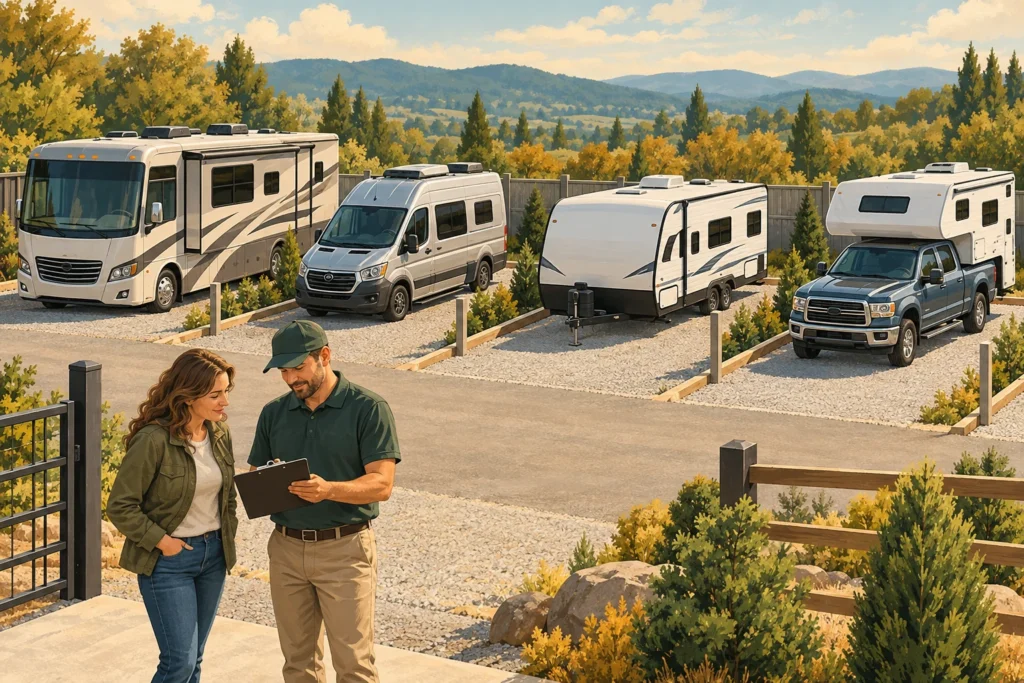
RV and Camper Storage Near Me: Confirm Your Vehicle Is Accepted
Match your actual vehicle and storage configuration to the operator’s rules. A practical acceptance worksheet prevents mismatched reservations and move-in surprises.
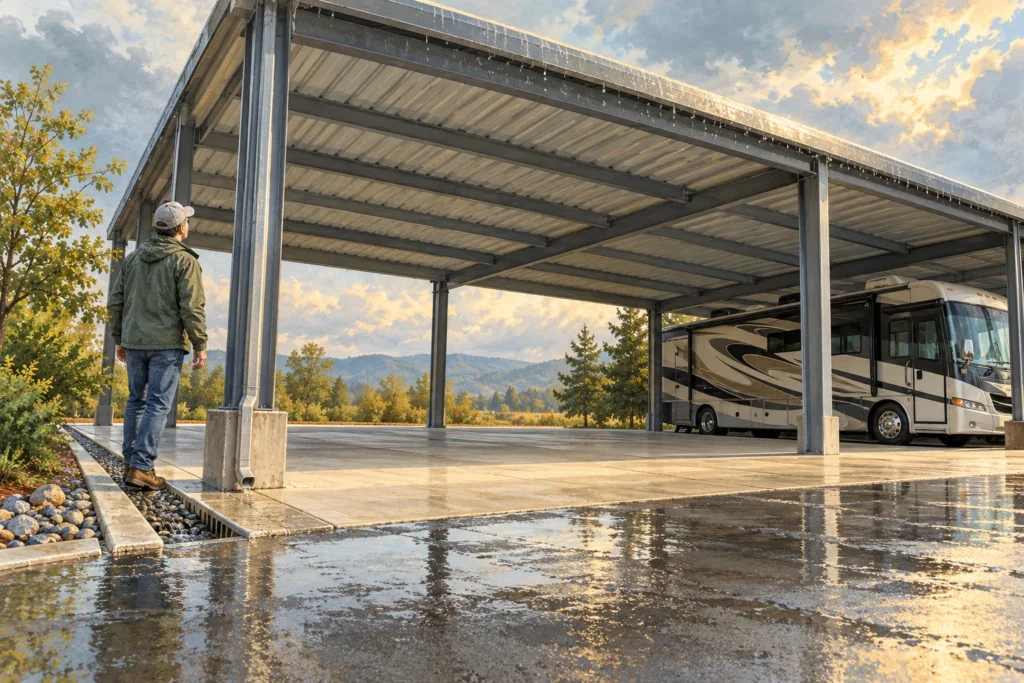
Outdoor Covered RV Storage Near Me: Inspect the Actual Bay
Inspect the actual covered bay for approach clearance, canopy columns, roof runoff, and everyday access. Take a practical survey sheet to your site visit.